
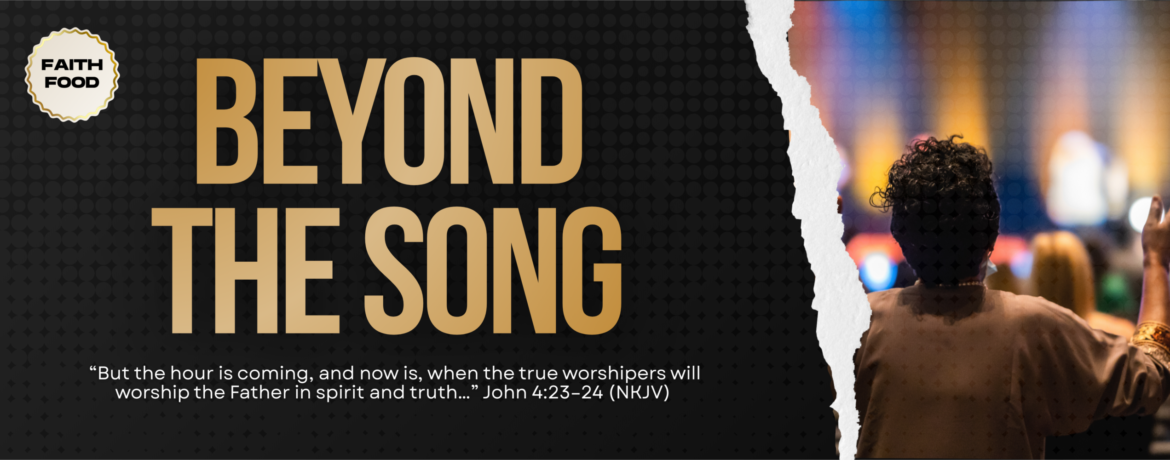
- Faith Food
BEYOUND THE SONG
Beyond the Song: The Power of Costly Praise
Scripture reminds us again and again that “the Lord is good; His mercy endures forever” (Psalm 136:1). As we reflect on the power and meaning of praise, we are reminded that praise is not merely a moment in a church service, but a posture of faith, a way of life anchored in trust in God’s unchanging nature.
Psalm 52:9 declares, “I will praise You forever, because You have done it; and in the presence of Your saints I will wait on Your name, for it is good.” These words were written by David, not from a place of comfort, but from a place of deep pain and crisis. Many of David’s psalms were birthed in hardship, persecution, betrayal, and uncertainty. This alone teaches us a vital truth: praise that is acceptable before God is often praise that costs us something.
In Scripture, we see clearly that praise is not limited to singing fast or slow songs, or to moments when everything is going well. True praise is forged in adversity. When David insisted on purchasing the threshing floor of Araunah instead of receiving it for free, he said, “I will not offer burnt offerings to the Lord my God that cost me nothing” (2 Samuel 24:24). David understood that worship and praise must be sacrificial. It must come from a place of intention, preparation, and surrender, not convenience.
Praise is not a religious routine; it is a lifestyle. David said, “I will praise You forever,” indicating continuity, consistency, and resolve. He praised God not because circumstances were favorable, but because God was faithful. At the time David wrote Psalm 52, he was a fugitive, running for his life from Saul. He was hungry, homeless, rejected, and blamed for the death of innocent priests (1 Samuel 21–22). Yet he still declared, “You have done it.” This is the language of faith. Hebrews 11:1 defines faith as “the substance of things hoped for, the evidence of things not seen.” David praised God from a place of revelation, not manifestation.
The Bible gives us a rich understanding of praise through various Hebrew expressions. One of the most profound is halal, which means to boast, to shine forth, to celebrate God with joyful abandon. It is the root of “hallelujah.” David expressed this kind of praise when he danced before the Lord with all his might, unconcerned with human dignity or royal protocol (2 Samuel 6:14–22). Though despised by Michal, God honored David’s heart and rejected pride masked as decorum.
Another expression of praise is tehillah, a spontaneous song that rises from the heart. Scripture says God inhabits the praises of His people (Psalm 22:3), and often those praises are birthed in moments of deep encounter, not rehearsed performance. Yadah speaks of lifting hands in surrender and gratitude (Psalm 134:2). Zamar involves musical expression and creativity (Psalm 150:3–5). Shabach is loud, triumphant praise, an uninhibited shout of victory (Psalm 47:1). Todah is perhaps the most challenging—it is a sacrifice of thanksgiving, offered before the breakthrough comes (Psalm 50:14).
David’s life reveals that praise is not dependent on circumstances. Though anointed king as a teenager, he spent years hiding in caves, rejected by family, betrayed by allies, and hunted by enemies. He feigned madness among the Philistines to survive (1 Samuel 21:13), endured rebellion from his own son Absalom (2 Samuel 15), and faced God’s discipline after his sin with Bathsheba (Psalm 51). Yet in every season, David continued to write songs of praise. He understood that praise is a response to who God is, not merely to what God does.
Psalm 103:1–5 captures this beautifully: “Bless the Lord, O my soul, and all that is within me, bless His holy name… who forgives all your iniquities, who heals all your diseases, who redeems your life from destruction.” Many of God’s battles on our behalf happen unseen. Like Elisha’s servant whose eyes were opened to see the chariots of fire surrounding them (2 Kings 6:16–17), we often do not perceive the protection, deliverance, and mercy God continually provides. Yet praise flows from remembering His benefits, even those we never knew we needed.
Praise also brings us into alignment with heaven. Jesus taught us to pray, “Your kingdom come, Your will be done on earth as it is in heaven” (Matthew 6:10). Praise invites heaven’s reality into earthly situations. This is powerfully illustrated in Acts 16:23–26, where Paul and Silas, beaten and chained in prison, prayed and sang hymns at midnight. Their praise was not delayed until deliverance came; it preceded it. The result was a divine earthquake, broken chains, and open doors. Praise shifted the atmosphere and released God’s intervention.
Midnight represents moments of confusion, exhaustion, and unanswered questions. It is the season when human strength ends and faith is tested. Yet Scripture shows us that praise offered at midnight carries unusual power. It declares trust when logic fails, hope when evidence is absent, and confidence in God’s faithfulness despite uncertainty.
Ultimately, praise is an act of faith. Without faith, it is impossible to please God (Hebrews 11:6). Praise that waits for perfect conditions misunderstands its purpose. David praised because God had already spoken. He praised from the certainty that if God said it, it was already done. This is why praise is not transactional—“I praise so God will act”—but relational—“I praise because I trust who God is.”
As believers, our circumstances should not dictate our praise. Whether in abundance or lack, joy or sorrow, clarity or confusion, our hearts are called to remain inclined toward worship. Praise offered in faith draws us closer to God, invites heaven into our situation, and transforms us even before our circumstances change. Like David, may we say with confidence, “I will praise You forever, because You have done it.”
Leave A Comment Cancel reply
Copyright ©2024 Fountain of Praise Christian Centre. All Rights Reserved